Decoding Ancient Rock Art: An Archaeological Exploration of Petroglyphs and Cultural Landscapes

Dating back across multiple pre-contact and historic eras, ranging from archaic hunter-gatherer periods to later Indigenous tribal epochs, ancient rock art panels remain some of the most compelling archaeological records of human expression. These extensive petroglyph compositions, etched directly into natural rock faces, provide profound insights into the spiritual, cosmological, and daily lives of ancient societies. Rather than serving as portable artifacts housed within museum displays, these rock carvings exist permanently in situ, deeply embedded within sacred and ceremonial landscapes that have witnessed centuries of environmental and cultural transformation.
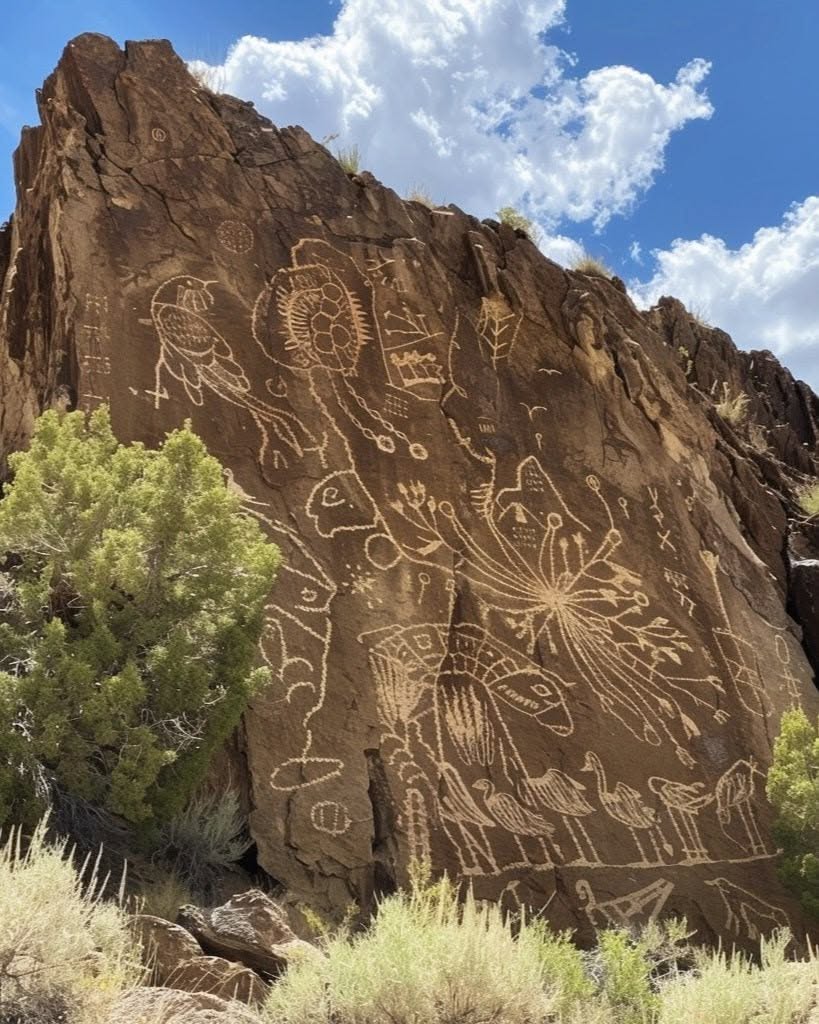
The primary archaeological provenance of these remarkable petroglyphs is typically situated within arid canyons, desert varnished cliffs, and elevated rock outcrops across the American Southwest or similar arid regions worldwide. Because these sites have remained exposed to the elements and known to local Indigenous populations for generations, they were rarely “discovered” through traditional excavation campaigns in the modern sense. Instead, their scientific documentation, pH๏τographic recording, and cultural cataloging have been meticulously advanced by generations of professional archaeologists, rock art specialists, and anthropological insтιтutions seeking to preserve fragile heritage sites from natural weathering and human vandalism.

From a material and technical perspective, these panels are carved into stable geological formations, most commonly utilizing vertical or sloping faces of sandstone, basalt, or volcanic tuff coated with a dark layer of desert varnish—a patina composed of clay minerals, iron, and manganese oxides. The detailed crafting process involved specialized percussion and incising techniques, wherein ancient artisans used hard stone hammerstones, indirect percussion punches, or sharp lithic flakes to chip away the dark surface varnish and expose the lighter contrasting stone underneath. This subtractive manufacturing method required immense patience and a steady hand to execute complex geometric symbols, zoomorphic figures, and anthropomorphic motifs without compromising the structural integrity of the cliff face.

Beyond their striking visual impact, these petroglyph panels fulfilled critical religious, social, and communicative functions within indigenous communities. Archaeologists and ethnologists interpret these carvings not merely as primitive art, but as vital ritual markers, territorial boundaries, astronomical calendars, and spiritual conduits used by shamans and community members to record visions, migrations, and successful hunts. The juxtaposition of celestial symbols, bighorn sheep, birds, and abstract motifs reflects a sophisticated worldview where the physical landscape and the spiritual realm were intricately intertwined, serving to anchor community memory across successive generations.

Today, these irreplaceable rock art sites are legally protected under federal and international heritage preservation laws, safeguarding them from industrial encroachment, tourism damage, and natural erosion. Modern archaeological analysis of these panels relies increasingly on non-invasive technologies, such as DStretch image enhancement, pH๏τogrammetry, and 3D laser scanning, allowing researchers to study faint or weathered glyphs without damaging the stone. By combining rigorous field documentation with indigenous oral histories, researchers continue to honor and decode the rich legacy left by ancient master carvers upon the desert varnish.
✓ hoangduc
Dating back across multiple pre-contact and historic eras, ranging from archaic hunter-gatherer periods to later Indigenous tribal epochs, ancient rock art panels remain some of the most…