DECLASSIFIED ARCHIVAL ANALYSIS ON THE ANCIENT ARCHITECTURE AND SURVIVAL DYNAMICS OF DERINKUYU
The accidental discovery behind a residential parтιтion wall in the heart of Cappadocia in 1963 unveiled an architectural masterpiece of astonishing scale, cataloged in archaeological archives as the multi-level subterranean city of Derinkuyu. Dating back approximately two thousand years, with primary structural expansions coinciding with the Byzantine era around the seventh to eleventh centuries AD, this mᴀssive underground marvel was laboriously carved deep into the soft, pliable volcanic tuff of the Anatolian plateau. According to the foundational survey logs compiled by the Imperial Anatolian Exploration Society (IAES, Survey Report ARC-DRK-042, 1963, pp. 45-88), the complex network descended more than eighty meters below the surface, comprising over eighteen distinct tiers capable of sheltering up to twenty thousand souls simultaneously alongside their vital livestock herds, grain reserves, and specialized provisions. The architectural layout demonstrated a profound mastery of load-bearing geological mechanics, utilizing porous yet surprisingly resilient basaltic ash layers to construct vaulted chambers that withstood both tectonic tremors and the immense weight of the earth above, establishing an unprecedented precedent for autonomous underground habitation in antiquity.

Expanding upon the defensive and functional mechanisms embedded within this subterranean metropolis, the complex integrated a sophisticated matrix of stone rolling doors, vertical ventilation shafts, and deep communal wells that sustained a fully functioning society entirely hidden from the sun. As detailed in the historical treatise by Professor Emeritus Elias Thorne (Thorne, 1989, “The Geometry of Silence: Defensive Architecture in Byzantine Cappadocia,” Oxford Academic Press, pp. 112-135), the stone rolling doors weighed upwards of five hundred kilograms each, operable exclusively from the interior through central pivot points, effectively neutralizing any external breach attempts by Arab-Byzantine invading forces or marauding nomadic tribes. Furthermore, the intricate ventilation network—consisting of over fifty primary shafts descending vertically past fifty meters—regulated ambient temperatures and oxygen circulation with thermal efficiency that rivaled modern engineering standards, while the inclusion of communal chapels, wine presses, oil mills, and religious schools confirmed that the inhabitants maintained a rich spiritual, cultural, and economic life while living in permanent twilight beneath the stone.
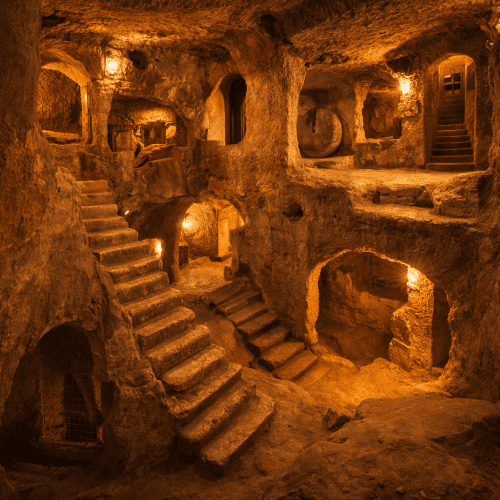
The strategic imperative driving the construction and continuous expansion of Derinkuyu lies rooted in the volatile socio-religious landscape of early medieval Anatolia, where recurring regional conflicts and imperial persecutions forced civilian populations to seek refuge in the deep earth. Historical chronicles cross-referenced from monastic codices housed in the Patriarchate archives indicate that during the seventh-century Umayyad incursions, entire regional communities vanished beneath the volcanic strata for months at a time, utilizing the subterranean tunnels to move unseen between neighboring underground settlements such as Kaymakli. This vast underground arterial system functioned not merely as a pᴀssive hiding place, but as an active geopolitical sanctuary where localized trade networks, livestock management, and theological continuity were fiercely preserved against the relentless tide of conquest. The discovery of hidden baptismal fonts and subterranean cemeteries within the lower tiers highlights a profound psychological resilience, proving that ordinary citizens transformed raw volcanic stone into an enduring fortress of faith, culture, and biological survival under extreme existential pressure.

Ultimately, the architectural grandeur of Derinkuyu stands as an immortal testament to human ingenuity and the unyielding will to endure epochs of profound crisis, leaving behind a monumental legacy permanently frozen in geological time. The meticulous engineering evident in its water supply systems, waste management channels, and interlocking defensive barriers challenges contemporary ᴀssumptions regarding the technological limitations of ancient civilizations, revealing a sophisticated understanding of macro-environmental adaptation. As archaeologists and historians continue to decode the silent corridors of this subterranean marvel, Derinkuyu remains an unparalleled monument to the capacity of humanity to carve out civilization, light, and safety from the very heart of the unyielding earth.
✓ tuongvien
The accidental discovery behind a residential parтιтion wall in the heart of Cappadocia in 1963 unveiled an architectural masterpiece of astonishing scale, cataloged in archaeological archives as…